


Design Your Room
Resources for designing your new kitchen.
Read More
The work triangle is a time-tested guideline of kitchen design that helps plan out efficient kitchen workspaces with clear traffic lanes. Imagine a triangle that connected your cooktop, your sink, and the refrigerator. This is the work triangle. According to the guidance of the National Kitchen and Bath Association, each leg of the triangle should measure between 4 and 9 feet. This allows a cook to reach their cooking, cleaning, and food storage areas with ease, while providing enough space between them to avoid crowding.
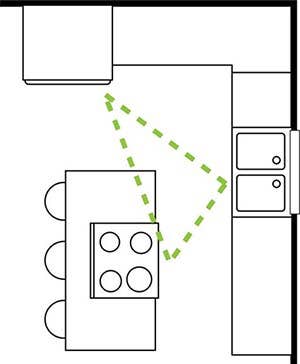
The kitchen triangle rule has substantial application in the design and layout of a kitchen.
It’s important to remember that the work triangle guidelines are not laws, and not rules. If you look back into the history of how the work triangle developed, you’ll find that it originated in the 1940s when kitchens were smaller, and designed as a utilitarian work area for housewife to create family meals.
Today, our kitchens are large, and in many families there is more than one cook. Moreover, our kitchens today have a broader range of functions than just cooking. They’re also where we dine, entertain, and work. Therefore, kitchen designers don’t select kitchen layouts exclusively around the work triangle approach but have adopted a work zone approach.
Today’s kitchen isn’t just about cooking and cleaning. As the hub of the home, the kitchen is more multi-functional than ever. Therefore, kitchen designers have to think more flexibly, and lay out spaces based on the particular activities that will take place there based on their clients’ needs.
Your kitchen can be broken down into four basic zones. Each zone defines a certain activity in the kitchen:
This is where you store your consumable and non-consumable items. Fresh food, frozen food, as well as dry goods, cans, and other non-perishables. You can think of this zone where you place your main pantry and refrigerator. Keeping these areas close can make it easy to get all the ingredients you need. Additionally, a lot of storage must be dedicated to non-consumable items like silverware, tableware, utensils, pots and pans, baking trays, and more. You’ll also want to consider where you’ll store odds-and-ends like cookbooks, scissors, and other desk items. Many non-consumables are located in drawers and upper cabinets.
This area is typically built around the sink, but also includes the dishwasher, garbage, recycling, household cleaning items, and a broom or mop. Consider installing waste cabinets near the sink to create a convenient space to keep your kitchen clean.
Food preparation requires easy access to utensils, cutting boards, and mixing bowls, as well as plenty of countertop space. Consider what you need for food preparation when planning storage options like base drawers, roll-out cabinet shelves, and prep sinks. These items will be key in making sure the kitchen runs smoothly and you are able to prepare meals efficiently.
In addition to your cooktop, consider your microwave and/or built-in oven. For cooking storage, you need to plan landing spaces for hot dishes, as well as storage space for utensils, pots and pans, bakeware, and so on. Think of how you cook. Is a cookbook out? Measuring cups? Spatula that you just stirred with? Towel for cleaning minor spills? These types of things rapidly eat up counter space.
It’s common for kitchens to have other zones, or for some of the work zones to have multiple uses.
A charging station for mobile phones, tablets, and other devices is becoming increasingly important in kitchen design. Take a look at special outlets with USB ports, and be sure the devices are safely out of toddlers reach and away from water.
Creating a space to eat in your kitchen depends on your family’s needs. Whether it’s just your family, or you’re entertaining, it seems everyone eventually gathers in the kitchen. Islands and peninsulas provide great kitchen dining spaces and can be multi-purpose. If lack of space is an issue, your island can double as prep, work, and entertainment space.
Like it or not, work happens at home and often in the kitchen. The good news is, you no longer need a massive workstation. Large desktop computers have given way to wireless laptops and tablets. Provide enough outlets to be able to charge all your electronic devices.
Many homeowners have a television in their kitchen. Others have a bar area that can accommodate stools or serve as a stand-or-sit space for cocktails or dinner. Consider including a conversation zone in your kitchen, with lounge chairs and a low table or versatile ottoman.
Resources for designing your new kitchen.
Read More
All about the kitchen, from design ideas to style trends.
Read MoreThe kitchen work triangle benefits the overall design function and is meant to create a tighter, more efficient workspace. It’s made up of 3 legs that should be 4 to 9 feet in length with its entirety at 26 feet or less. Each leg connects to the refrigerator, cooktop, and sink. This is because these 3 areas are considered the most important and heavily used spaces in the kitchen. Kitchen islands or other obstacles should not intersect any of the 3 legs.
No. The work triangle is still valuable when deciding the layout of a kitchen. A kitchen work triangle makes sure that the space is laid out in the most functional and efficient way possible.
The kitchen work triangle is still the traditional way to layout a kitchen. A newer and more modern approach is the five-zone kitchen which has become increasingly popular. This type of kitchen is perfect for the homeowner who needs a multi-purpose space that can accommodate more daily activities than just cooking.
One of the most popular, versatile kitchen floor plans is the L-shaped layout. It creates an open concept design that includes 2 workspaces on adjoining walls. The L-shaped layout is also great for entertaining because it’s commonly paired with an island and leads into other open living spaces.
The kitchen work triangle benefits the overall design function and is meant to create a tighter, more efficient workspace. It’s made up of 3 legs that should be 4 to 9 feet in length with its entirety at 26 feet or less. Each leg connects to the refrigerator, cooktop, and sink. This is because these 3 areas are considered the most important and heavily used spaces in the kitchen. Kitchen islands or other obstacles should not intersect any of the 3 legs.
The one-wall kitchen is a layout that doesn’t include a work triangle. This kitchen design is usually chosen to maximize space in smaller kitchens. Everything is installed on one wall including kitchen cabinets, appliances, and a sink. There’s no work triangle within the one-wall kitchen because it would close off an already tight space.
The distance between the stove and refrigerator should be between 4 and 9 feet. Keep in mind, no side of the triangle should cut through a kitchen island or peninsula by more than 12 inches.